Baby Eyes Starting Look Green at 4 Weeks Old
Everything you need to know most your baby'due south vision
- A newborn's vision takes fourth dimension to develop
- Baby vision development starts during pregnancy
- Newborn vision at birth
- Your baby's eyes: The first calendar month
- Months two and 3
- Months four to 6
- Months 7 to 12
- Eye alignment issues
- Premature babies and eyesight problems
- No-cost center exams for infants
A newborn's vision takes time to develop
The first time a babe opens their eyes and makes middle contact is one of the greatest moments a new parent tin experience. But don't be concerned if that moment doesn't happen right away.
A baby's vision will take some time to develop. In the get-go week of life, babies don't encounter much detail. Their first view of the globe is indistinct and only in shades of greyness.
It takes several months for your newborn's eyesight to develop fully. Knowing the milestones of your babe's vision evolution — and what y'all can do to help it along — ensures your child is seeing properly and enjoying their world to the fullest as presently every bit possible.
Baby vision development starts during pregnancy
Your baby's vision starts to develop before they're fifty-fifty born.
How you care for your own body during your pregnancy is extremely important for the development of your baby'due south trunk and mind, including the optics and the vision centers in the brain.
Be sure to follow the instructions your OB-GYN gives you regarding proper nutrition, including supplements, and go the proper amount of rest y'all need during your pregnancy.
Avoid smoking and consuming alcohol or drugs during pregnancy, as these toxins can cause multiple bug for your baby, including serious eyesight bug.
Smoking is specially hazardous during pregnancy, as cigarette smoke contains an estimated 3,000 dissimilar chemicals that tin can potentially harm humans — including carbon monoxide, a known fetal toxin.
Fifty-fifty taking common medications like aspirin can be dangerous to your infant when yous are pregnant, increasing the take a chance of depression birth weight and problems during delivery. Low nativity weight has been associated with an increased take chances of vision problems in infants.
Always talk to your OB-GYN earlier taking whatever medications during your pregnancy, including over-the-counter medicines, herbal supplements and other non-prescription remedies.
Run into RELATED: How pregnancy can affect your vision
Newborn vision at nativity
Soon afterwards birth, your doctor will briefly examine your infant's eyes to rule out signs of congenital cataracts or other serious neonatal heart issues. Though such eye problems are rare, they must be detected and treated early to minimize their impact on your child's vision evolution.
An antibiotic ointment is usually applied to your newborn's eyes to aid prevent an eye infection from bacteria present in the birth culvert.
At birth, your baby merely sees in black, white and shades of grey, since the nerve cells that control vision in the retina and brain aren't fully developed.
At this stage, a newborn's optics tin can't focus on near objects. Don't be concerned if your baby doesn't seem to exist "focusing" on objects, including your face up. Information technology just takes fourth dimension.
Despite these visual limitations, studies show that, inside a few days later on nascence, infants adopt looking at an image of their mother'due south face to that of a stranger. [Read more almost the importance of eye contact for child development.]
Researchers believe this preference depends on large, high-contrast stimuli, like the boundary of the mother's hairline to her face up. In studies, if these boundaries were masked with a scarf or bathing cap, the infants' preference of looking at their mother's face went abroad.
To encourage visual interaction with your newborn child, try to keep your hairstyle the same and avert altering your appearance.
One thing y'all may observe virtually your newborn son or daughter is how big their eyes are. This is considering normal infant development proceeds from the head down.
At nativity, your babe's optics are already 65% of their developed size!
Meet RELATED: What nursery colors are best for a baby's vision?
Your babe's optics: The first month
Your babe's optics are not very sensitive to light in the first month after birth.
In fact, the amount of low-cal required for a 1-month-old baby to be aware that light is nowadays is 50 times higher than that of an adult.
That ways that information technology's okay to get out some lights on in the nursery. It won't bear on their ability to slumber, and it may keep y'all from stubbing your toe in the night room.
Infants starting time to develop the ability to see in colors very quickly. One calendar week after birth they can see crimson, orange, yellow and dark-green, simply it takes a little longer for your infant to be able to meet blueish and violet.
Why? Bluish light has shorter wavelengths, and fewer color receptors be in the human eye for blue calorie-free.
Don't be too concerned if your infant's eyes don't always announced to be working together as a team early on.
One eye may occasionally drift inward or outward from proper alignment. This is normal, but if yous see a large and abiding misalignment, notify your eye dr..
Tips
To assist stimulate your baby'due south eyesight during this period:
-
Decorate their room with bright, cheerful colors.
-
Include artwork and furnishings with contrasting colors and shapes.
-
Try hanging a brightly colored mobile that features a variety of colors and shapes.
Months 2 and 3
Baby vision makes several important advances during months two and three. Infants develop sharper visual acuity during this period, and their optics brainstorm to motility meliorate as a team.
Past this point, your infant should be following moving objects with their optics and reaching for things they come across.
Infants at this stage of evolution are learning how to shift their gaze from one object to another without having to move their caput.
Their eyes are now becoming more sensitive to calorie-free. At 3 months, an baby'southward calorie-free detection threshold is merely 10 times that of an developed. You lot may now want to dim the lights a chip more while they're sleeping.
Tips
To assist stimulate your 2- to 3-month-erstwhile babe'southward vision evolution, the American Optometric Clan recommends:
-
Add together new items to their room or oftentimes change the location of existing items, including their crib.
-
Talk to your infant as you walk around the room.
-
Keep a night light on to provide visual stimulation when your child is awake in their crib.
-
Let your baby crawl. While infants should be placed on their backs for sleep to decrease the chance of sudden infant death syndrome (SIDS), put them on their stomachs when they are awake and y'all can supervise them. This provides important visual and motor experiences.
Months 4 to six
By historic period 6 months, pregnant advances accept taken place in the vision centers of the brain, allowing your infant to come across more than distinctly and motion their optics more chop-chop and accurately while they follow moving objects.
Visual acuity improves from almost 20/400 at nascence to roughly 20/25 at vi months of age. Colour vision should exist like to that of an adult too, enabling your child to see all the colors of the rainbow.
Babies also accept amend hand-middle coordination at iv to 6 months of historic period, assuasive them to chop-chop locate and option upward objects. That includes accurately directing a bottle — and many other things — toward their oral fissure.
Half dozen months of historic period is also an important milestone because it's when your child should accept their kickoff children'due south eye exam (unless complications arise earlier this time).
Even though your baby can't read the letters on an centre nautical chart, your center doc can perform non-verbal testing to assess their visual vigil, detect nearsightedness, farsightedness and astigmatism, and evaluate middle teaming and alignment.
At this exam, your eye care practitioner will also check the health of your babe's optics and wait for anything that might interfere with normal and continuing vision development.
For the virtually thorough eye exam for your 6-month-old, y'all may want to seek the services of an eye doc who specializes in children'south eyesight and vision evolution.
Months 7 to 12
Your child is now mobile, crawling near and roofing more distance than you could ever take imagined. They are better at judging distances and more than authentic at grasping and throwing objects.
This is an important developmental menses for your kid. At this phase, infants are developing a improve overall sensation of their body and learning how to coordinate their vision with their movements.
Information technology's also a time that requires more diligence on your part to keep your baby from harm.
Bumps, bruises, middle injuries and other serious accidents tin can occur as they start to physically explore their environment. In particular, keep cabinets locked and put barriers in front end of stairs.
Don't be concerned if your baby's eyes are starting to change colour.
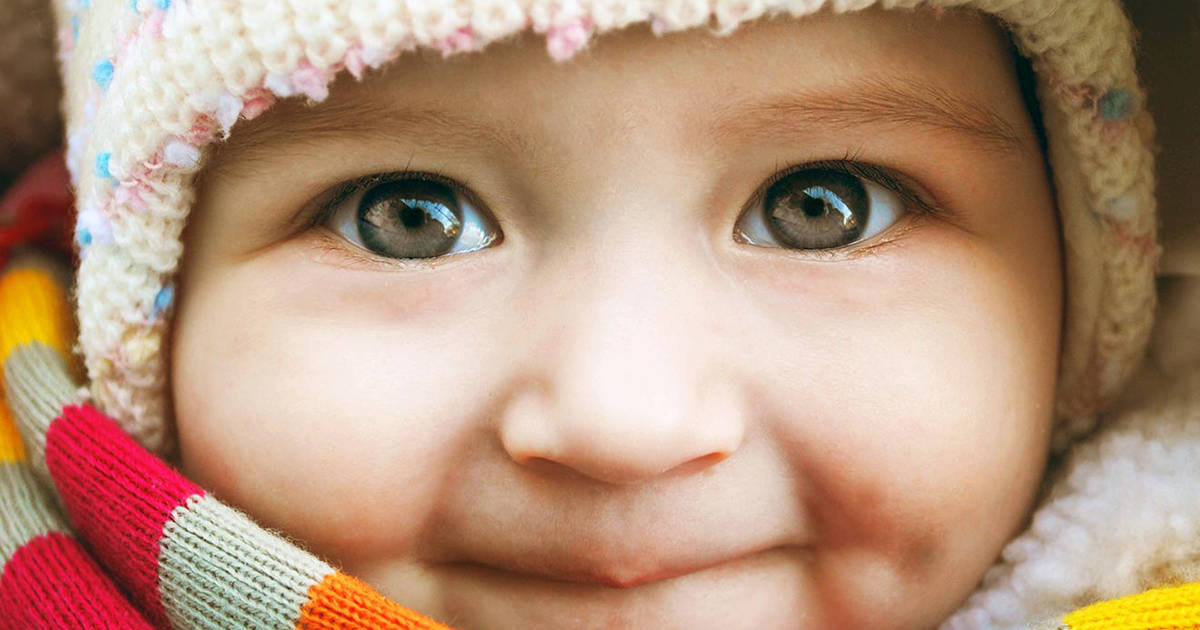
Almost babies are built-in with blue eyes considering darker pigments in the iris aren't completely developed at birth. Over time, more dark pigment is produced, which tin alter your child's center colour from bluish to brownish, green, gray or a mixture of colors — as is the case with hazel optics or heterochromia.
READ NEXT: Vision issues of preschool children
Tips
To stimulate the development of your child's hand-centre coordination:
-
Go down on the flooring with your baby and encourage them to crawl toward objects.
-
Place a favorite toy on the floor just out of reach and encourage them to get it.
-
Provide plenty of safe objects and toys that they can take autonomously and put together.
Centre alignment bug
Be sure to pay shut attention to how well your baby's eyes work together as a team.
Strabismus is the term for a misalignment of the eyes. It's important to discover and treat it early then your infant's vision develops properly in both eyes.
Left untreated, strabismus can lead to amblyopia, commonly known every bit "lazy middle."
It takes a few months for newborn optics to develop coordination skills, merely don't hesitate to contact your pediatrician or middle doctor if yous feel one of your babe's optics is misaligned or doesn't movement in sync with the other eye.
Premature babies and eyesight bug
The average length of a normal pregnancy is approximately 40 weeks. Babies built-in before 37 weeks of gestation are considered premature, co-ordinate to the World Health Organization.
Smoking during pregnancy significantly increases the risk of giving nascency prematurely.
Premature babies are at greater take a chance of eye problems than full-term babies, and the odds increase the earlier the kid is born.
2 vision problems are more common in premature babies:
Retinopathy of prematurity (ROP)
ROP is the abnormal replacement of normal tissue in the retina with fibrous tissue and claret vessels. It tin can cause scarring of the retina, poor vision and retinal detachment. In severe cases, retinopathy of prematurity can pb to incomprehension.
All premature babies are at take a chance of ROP. Very low birth weight is an additional risk factor, especially if it is necessary to place the babe in a high-oxygen environment immediately afterward nascence.
If your babe is born prematurely, ask your obstetrician to refer you to a pediatric ophthalmologist and so they can perform an internal eye exam and rule out ROP.
Nystagmus
Nystagmus is an involuntary, back-and-along movement of both eyes.
In nearly cases, nystagmus causes the eyes to drift slowly in 1 direction and and so "jump" back in the other management. The center movements are usually horizontal, but they can exist diagonal or rotational as well.
Nystagmus can be present at birth, or it may develop weeks to months later. Take a chance factors include albinism, congenital cataracts and incomplete evolution of the optic nervus.
The magnitude of the eye movements will usually determine how much the infant's vision and visual development will be affected.
If your baby shows signs of nystagmus, consult a pediatric ophthalmologist or other centre dr. equally soon equally possible.
No-toll centre exams for infants
If yous can't afford an middle exam for your infant, assist is bachelor.
Developed by the American Optometric Association in partnership with The Vision Care Found, InfantSEE is a public health program designed to brand sure vision intendance becomes a part of baby wellness routines in the United States.
Under this program, member optometrists offer a no-cost outset eye cess for infants within their first twelvemonth of life.
To learn more nearly InfantSEE and to detect a participating optometrist, visit the InfantSEE website.
READ More than: Practise your eyes grow?
Page published in Feb 2019
Page updated in Feb 2022
Source: https://www.allaboutvision.com/parents/infants.htm
0 Response to "Baby Eyes Starting Look Green at 4 Weeks Old"
Post a Comment