Obituary Sta Maria Village Zamboanga City Viray Family
I t's a timber-clad house with open-program living, pale floorboards and large windows giving views across Chichester culvert. This building designed by London-based Baca Architects has a unique characteristic – information technology floats.
Completed this month, the amphibious firm was developed equally a epitome by Baca and Floating Homes, a manufacturer specialising in flood-resilient housing, in response to a competition launched last twelvemonth to find a solution to London's housing crisis.
The firm is intended to be practical, affordable (a two-bed unit will sell for £200,000) and equipped to bargain with floods, by rising with the water levels. Ultimately the company wants to unlock redundant waterways by building on "bluespace" sites – manmade docks, canals and marinas – beyond London.
"Collectively, bluespace has the potential to evangelize as many as seven,500 floating homes with minimal disruption to existing communities", says Richard Coutts, director at Baca Architects.
Floating architecture has real potential to assistance ease some of London's housing issues, says Alex De Rijke of dRMM architects, which won a competition to design the Great britain's kickoff floating villages in London Docklands.
"Architecture can only respond to overpopulation by addressing the questions of density, economy and speed of structure," says de Rijke, "The space of big rivers in urban areas can offer answers to these questions."
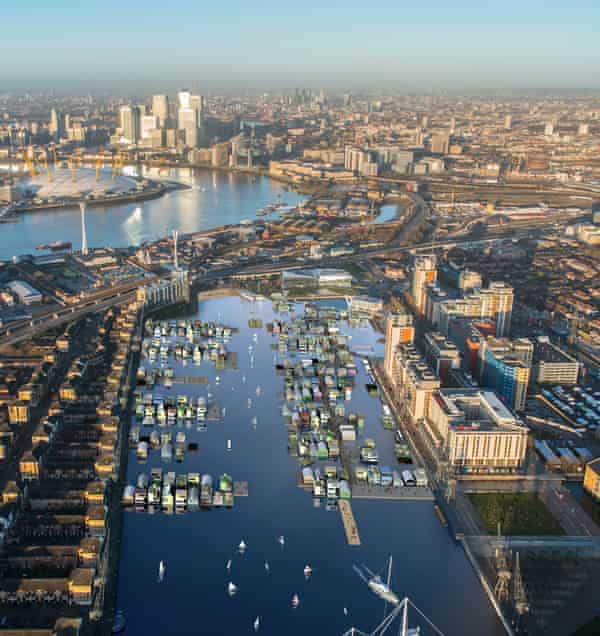
Architects and city planners across the world are starting to wait across the traditional confines of the city, towards building on h2o every bit i of the answers to reducing inner-city population density and too developing flood-resilient designs. Global damage to cities from flooding could amount to $1tn a yr by 2050 if no activity is taken, according to a Globe Bank study.
Floating architecture is nothing new. Traditional floating villages are common in deltas and forth the Mekong river in south-eastern asia. Simply integrating age-old designs into a modern city is a different matter entirely.
Some cities are further ahead than others. IJBurg is a collection of floating houses built on six artificial islands on IJ Lake in Amsterdam, designed by Marlies Rohmer. It was conceived to deal with the city'due south critical housing shortage problem as well as its vulnerability to flooding – more than half of the Netherlands is at or below sea level.
The housing is a mix of expensive waterside condos and social housing, with most xxx% of the community's eighteen,000 houses allocated to low-income residents. When complete, the evolution will provide homes for 45,000 residents on ten islands.
In Copenhagen, architecture business firm Urban Rigger has unveiled floating student housing fabricated from end of life shipping containers. Each Urban Rigger has 12 studio apartments which share a courtyard complete with a BBQ area, bike racks and a kayak landing, and is powered in office past solar energy.
Tethered to docks in the urban center, the first students are due to move at the terminate of the year and volition pay around £500-£600 a month. Over the next decade, the company plans to build 1,000-1,500 containers in "harbour, canal and river intensive cities" across Europe, says founder Kim Loudrup.
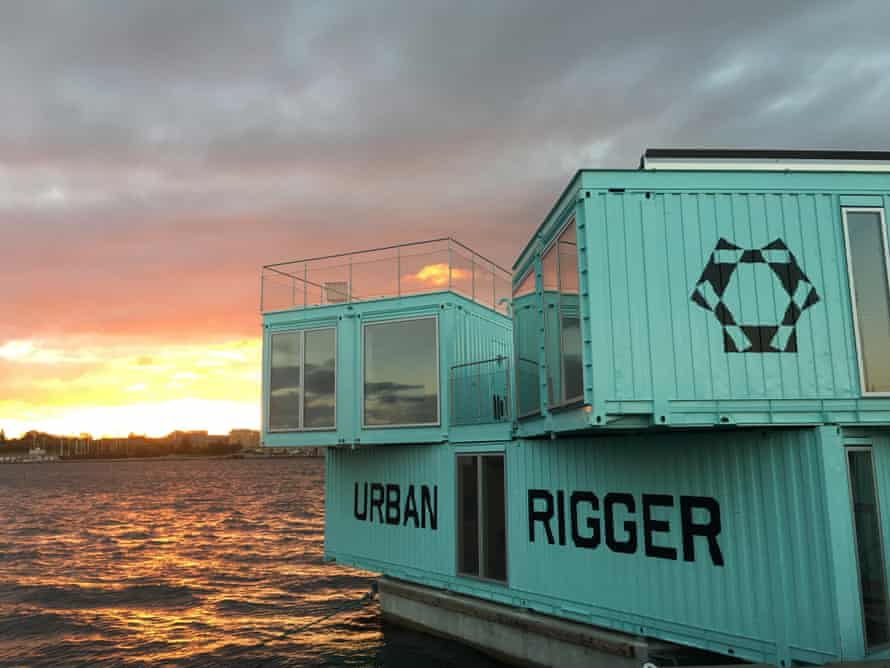
It's about "using infrastructure that'southward non being used for annihilation apart from looking overnice", says Loudrop, who admits floating housing is "but role of the puzzle" when it comes to solving city housing crises. The beauty is, he says, that this kind of housing "can exist initialised and utilised immediately; it comes in, stays for a menses of time and and so can move away over again."
Building on h2o isn't straightforward, all the same. The recent collapse of the Makoko Floating School in Lagos, i of the most famous examples of floating architecture, shows some of the complexities.
The award-winning lagoon construction designed by Nigerian architect Kunlé Adeyemi of Dutch studio NLÉ Works was built to provide a school and community centre to a floating slum in the city but complanate in June after heavy rainfall.
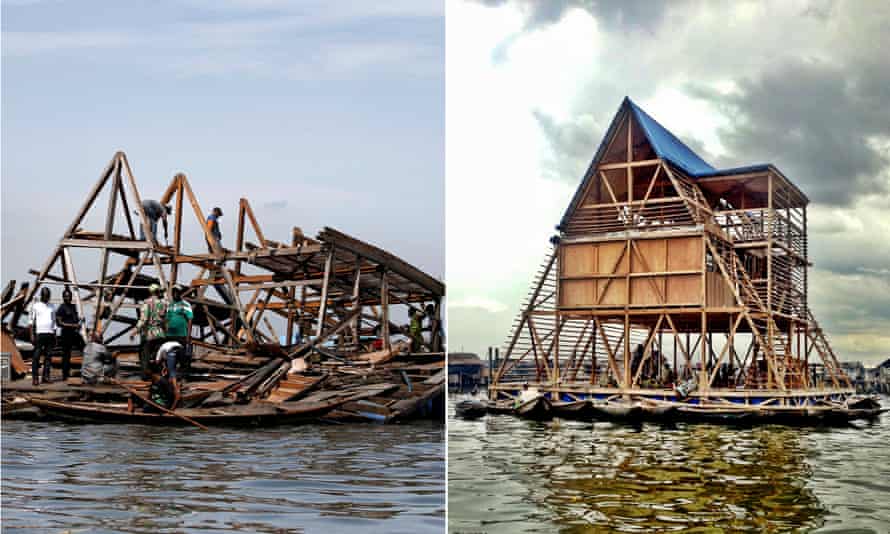
Adeyemi says that the building had been decommissioned for months and was merely intended every bit a prototype. But it led to a row as a local headmaster, Noah Shemede, raised concerns about the viability of the structure.
There are as well environmental concerns. The demand for foundations of many floating buildings to get deep into the river bed, for example, will accept an impact on the surround, says Phillip Mills, manager of the Policy Consulting Network, and a specialist in water construction.
"Foundations or structures within the river could too modify the river bed with silt erosion and degradation elsewhere in the river. The same matter already happens around bridge piers," he says.
Building floating structures tin can besides severely alter the menstruum of a river such as the Thames and disrupt transport, a spokesperson from the Port of London Authorization explains. "What might accommodate property owners or private developers all-time is non always best for the urban center. Londoners have said they want to see the Thames used predominantly for transport or leisure. Any structures in the Thames could bear upon the menstruation of the river and create obstacles for watercraft."
Withal, Lucy Bullivant, adjunct professor of history and theory of urban design at Syracuse University, thinks at that place are greater ecology consequences building on state – such as the tendency to be more car focused – than on rivers. "Floating designs will create a practiced ballast signal for plants to aid foster biodiversity and create habitats for fish and birds."
Edifice on bluefield sights can be environmentally friendly, according to Mark Junak, director of Floating Homes. He says floating structures such as those at Noorderhaven in the Netherlands have recently been discipline to underwater drone surveys to find whether their construction has negatively affected the ecosystem.
Co-ordinate to the inquiry project, the underwater footage "revealed the existence of a dynamic and diverse aquatic habitat in the vicinity of these structures, showing that floating structures can accept a positive consequence on the aquatic surround".
For London architect Carl Turner, who has designed a pre-fabricated, open-source amphibious house specifically designed to bladder on floodwater, called the Floating House, climate change ways needing to work with water.
"You either protect the house or protect the land," he says. "Creating big-scale inundation protection zones is expensive and in itself potentially harmful to the surroundings. One time breached, homes are left defenceless, every bit opposed to floating homes that can simply rise with alluvion waters."
Source: https://www.theguardian.com/sustainable-business/2016/oct/29/floating-homes-architecture-build-water-overcrowding-cities-unaffordable-housing
0 Response to "Obituary Sta Maria Village Zamboanga City Viray Family"
Post a Comment