70 X 35 Hinged Four Panel Wall Art of Herons
The 4 painted of gods in their original frames known from antiquity were all constitute in the and date to between the beginning and fourth centuries Advertisement, most likely to the second century.1 A framed panel depicting Sobek and Amun, formerly in Berlin, was destroyed during World War II.2 Just three survive today: one of Sobek and Min in Alexandria,3 ane of Heron and a god with a double ax, in Brussels (fig. 9.i),4 and ane of Heron alone (fig. ix.two), in Providence, the discipline of this paper.
The precise archaeological context of the Providence panel—which was discovered all the same mounted in its original viii-betoken frame—is unknown. Likely unearthed in the 1930s, the piece of work was in Maurice Nahman's collection in Cairo by 1938 and appeared in the auction of Nahman'south collection at the Hôtel Drouot, Paris, in 1953. The Rhode Island School of Design (RISD) Museum in Providence purchased it from Mathias Komor Fine Arts, New York, in 1959.5
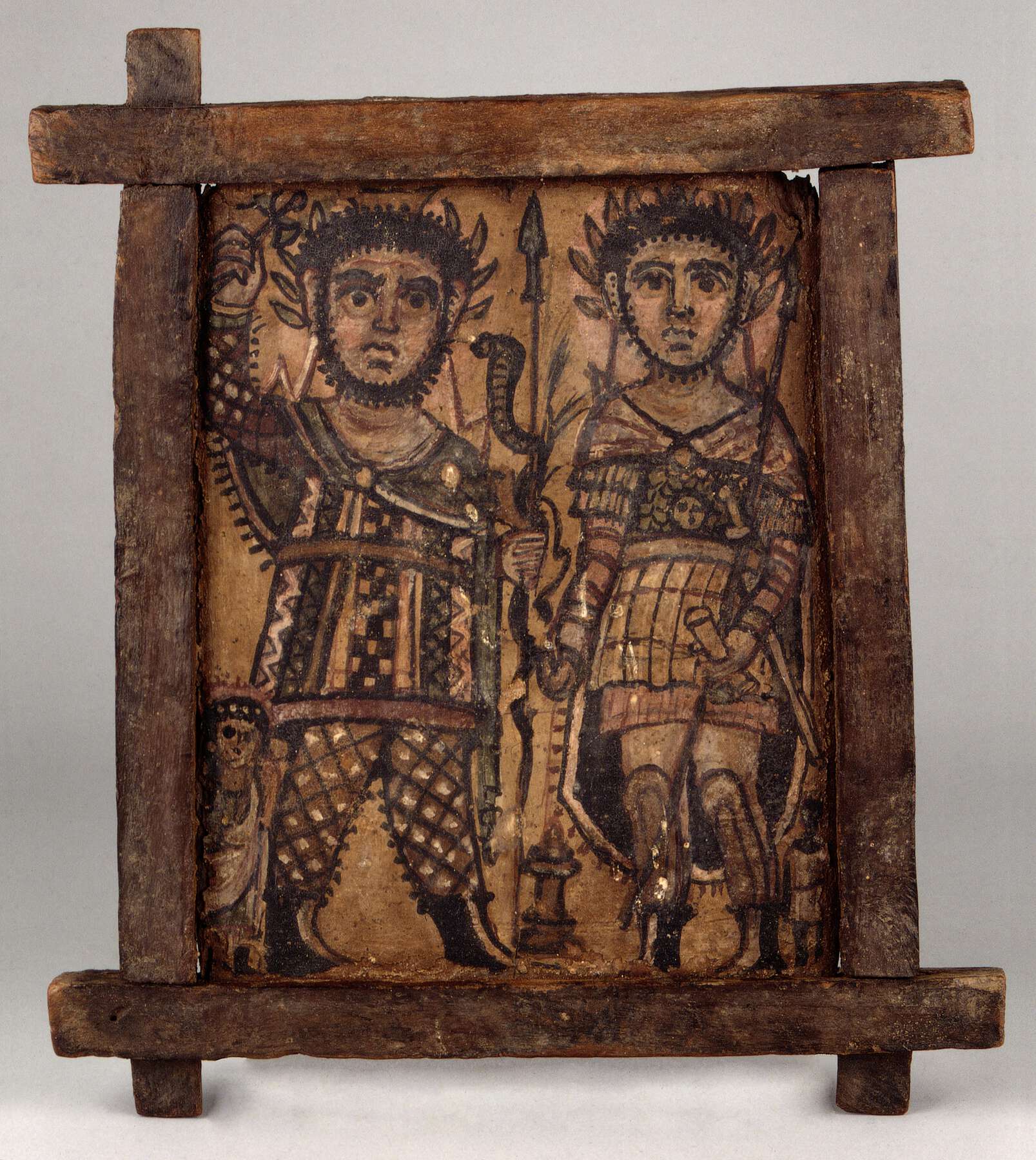 Figure nine.1
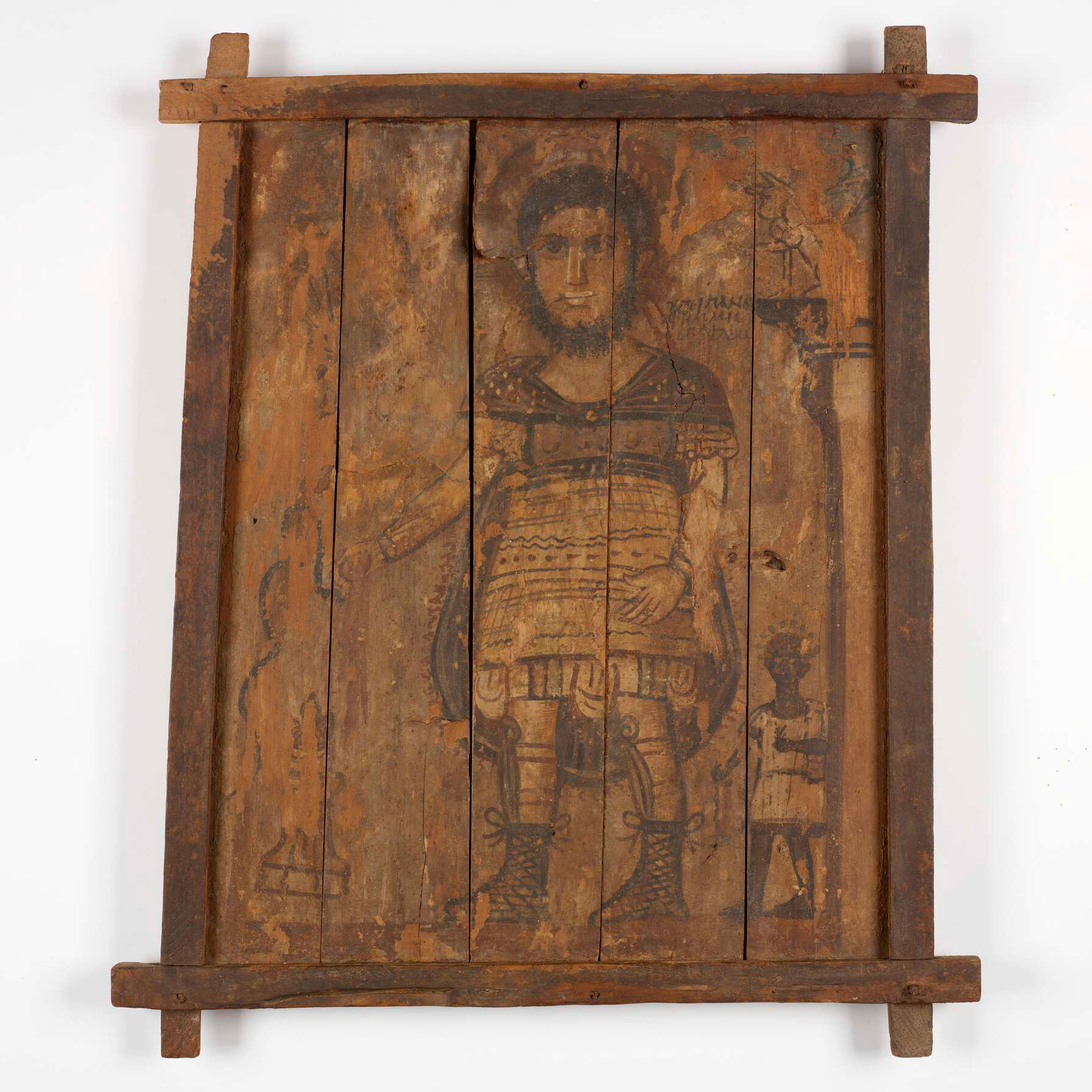 Figure 9.2
The RISD panel (run across fig. ix.ii) depicts the god Heron wearing a cuirass, pteruges, a fringed curtain, greaves, and laced boots. His feet are oriented in the same direction, in the Egyptian convention of depicting standing figures. Disguised and dark haired, his head crowned with a laurel and surrounded by a halo, Heron stares ahead with large eyes. Belongings a scroll in his proper left hand, he pours a libation on to the ground from a patera in his right hand, below which is a thymiaterion. Although dressed as a Roman soldier, Heron carries no weapons. To his left a small figure wearing a wreath and a brusk white offers a rose in his right manus and a bouquet in his left. The griffin of the goddess Nemesis, shown beside her wheel, crowns a cavalcade farther to Heron'due south left.6 Abreast the cavalcade is a Greek inscription that translates to "On behalf of Panephremmis, for a favor," naming the person for whom the painting was offered but not the actual donor.7
Although only a few of these framed panels of gods survive, many more examples must accept existed in artifact.viii The unpainted edges of other painted panels suggest that they were also originally framed. Among them are a panel of Heron in Berlin; one of Heron and a god with a double ax in a private collection in Étampes; ane of a goddess, possibly Isis, in Asyut; and one of Harpocrates/Dionysos in Cairo.9 Still, not all framed panels portray images of gods, as evidenced by a portrait of a adult female found in a grave in , now in the British Museum (fig. 9.3),10 and a portrait of a homo in the Getty.11
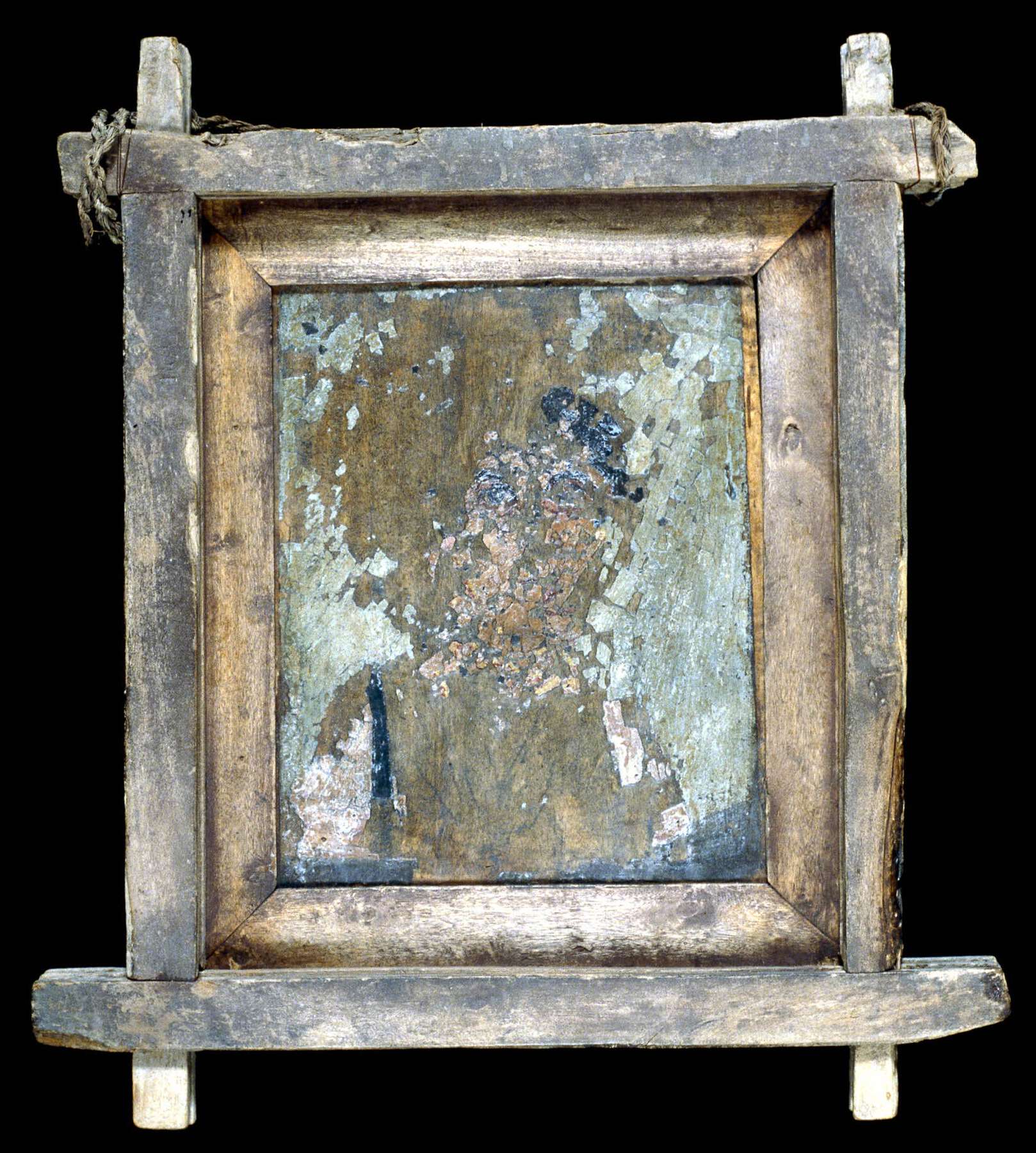 Figure nine.3
In construction, the RISD Heron panel, the largest of the extant framed panels, resembles the panel in Alexandria and the at present-lost Berlin panel.12 All three have been constructed of multiple slats of wood held together by an enclosing 8-signal frame. The Alexandria panel is equanimous of iii slats of woods, while both the RISD and lost Berlin panels are composed of five slats. Information technology appears that most framed panels were made from multiple slats, though smaller, single-panel examples did exist.13
The figure of Heron has been studied extensively in recent years, specially by the French scholar Vincent Rondot. In his book Derniers visages des dieux d'Égypte and in articles, Rondot reviewed by scholarship on Heron, explored his origins, and gathered and analyzed all known representations of him to date.14 Thomas Mathews explored images of Heron and other Romano-Egyptian panel paintings of gods equally precursors to Christian icons in his volume The Dawn of Christian Art in Panel Painting and Icons and in previous work.xv
Most scholars agree that Heron was not a native Egyptian god, only his origins are however debated. Some believe that he came from Thrace, where he was worshipped by soldiers, and that Thracian settlers brought him to Egypt in the Ptolemaic period.xvi Others, like Rondot, believe that Heron originated in the Virtually Eastward, where he protected travelers along caravan routes.17 Heron gained popularity every bit a protector god in Egypt during the offset centuries Advertizingxviii and was featured in wall paintings in various sites in the Fayum. In Karanis he appears dressed every bit a Roman soldier with a smaller effigy by his side,19 while in Magdola, wall paintings depicting Heron adorn a temple defended to him.twenty His images guard the archway of the temple of Sobek in Theadelphia: in wall paintings flanking the entrance Heron is depicted both adjacent to a equus caballus and offering incense at an altar in 1 painting, and on horseback and pouring a libation in the other.21
Although Heron is the sole subject in the RISD panel, save for the much smaller effigy abreast him, the other painted panels featuring Heron invariably testify him standing beside a god wielding a double ax.22 Stylistic details and a similar palette link the RISD Heron to a fragmentary console in Berlin (no. 15979) that shows Heron with dark curly hair and bristles, large eyes, a halo, and a cuirass decorated with a gorgoneion.23 An armed deity, suggested past the upright spear visible adjacent to the tree to Heron'due south right, in one case stood beside Heron in the Berlin work.
A purported shared origin associates the RISD panel with two other Heron panels. The framed console in Brussels (run into fig. 9.1; come across note 4), purchased by Franz Cumont in Paris in 1938, came from the same findspot (unfortunately not recorded) as RISD's panel, according to the seller.24 The Brussels Heron holds both a sword and a spear, in contrast to his unarmed representation in the RISD console. Adjacent to him is a scowling god, clad in a patterned, belted tunic, checked trousers, and fringed cloak, who raises a double ax in his right paw and grasps a spear in his left. A pocket-sized effigy of a woman wearing a wreath, , and stands to the god's right. Although this deity'southward identity remains elusive, Rondot has proposed that he is Lycurgus.25 Heron and Lycurgus entered the Egyptian pantheon in the Roman catamenia and became a often represented pair in the Fayum. In the Brussels panel, both wear haloes and wreaths, with the leaves enlarged and emphasized, perchance to indicate that in this context they are also associated with the Fayum'south bountiful harvests.26 Although the figures' proportions are similar in the RISD and Brussels framed panels, the painting styles differ. The figures in both panels are outlined, but the details in the Brussels panel are rendered in a flat, decorative manner within the bold outlines; this fashion stands in contrast to the endeavor at modeling and suggestion of volume evident in the RISD panel.
A fragmentary panel in Étampes has also been linked with the RISD and Brussels panels. Believed to have come from the same site, all three were in Maurice Nahman'southward drove before 1938. Both the Étampes and RISD panels appeared in the 1953 Paris auction of Nahman's collection.27 Depicting the same subject as the Brussels console, the Étampes panel portrays Heron younger, with a lighter beard. Heron and Lycurgus are rendered in a more than painterly way, with shading accomplished through delicate hatching rather than blocks of color. Instead of the predominantly warm chocolate-brown tones of the RISD and Brussels panels, the Étampes epitome features light purples and pinks as well as browns. Like the RISD panel, it bears an inscription, which translates as "Pathevis, son of Erieus, is the ane who [dedicated this piece of work], for a favor."28 The divergent painting styles employed in these framed panels announced to reflect the diverseness of styles in contemporary mummy portraits.
The inscription on the RISD and Étampes panels—ep' agatho, pregnant "for a favor"—indicates that these works were votive offerings. Inclusion of the donor's name in the RISD inscription would not accept been necessary if both panels had been offered together; i mention of the donor'due south name, Pathevis, would have sufficed.29 In both panels, the inscriptions are placed next to Heron's left ear and then he can hear the donor's appeals. The size and prominence of his ears are believed to allude to his special powers of hearing, and associate him with Egyptian gods who hear petitions.xxx In these paintings, Heron seems to model the proper mode to honor him: worshippers should offer libations and incense.
Another ep' agatho inscription offers a clue to the donor of these paintings. A partially preserved inscription on a fragmentary panel in London probable reads: "[missing name] the dekanos defended this painting [for a favor]."31 Although not a loftier-ranking official, the dekanos belonged to the elite of the Roman administration in Egypt. Thus, the local elite, who were memorialized in mummy portraits, likely also deputed framed panels of gods.32
Archaeological contexts for certain console paintings aid in determining their function. The panel of Soknebtunis and Min at present in Alexandria (no. 22978) was excavated in the temple of Soknebtunis in Tebtunis, in the second court of the temenos, an area that had become a glass workshop in afterwards Ptolemaic times just maintained some religious part later the temple was abandoned.33 The now-missing framed panel depicting Sobek and Amun (no. 15978)34 and the Berlin fragmentary Heron (no. 15979)35 were plant in a business firm in Tebtunis. When the structure was abased in the third century Advertising, the panels were left on the site, along with the hemp string and the peg in the wall from which the now-lost panel was hung.36 Framed painted panels in religious and domestic contexts are depicted in many mosaics and wall paintings that have been found outside Egypt.37 A mosaic from a Roman villa in Antioch depicts a man gazing at a framed panel while reclining at home,38 and another from Hadrian's Villa in Tivoli shows a framed console left in forepart of a statue of a god in an outdoor shrine.39 The various depictions of framed panels advise that they were much more mutual than the scattering of surviving examples would indicate.
The show provided by these different types of archaeological finds suggests that the framed panel paintings of Heron now in Providence, Brussels, and Étampes were probable installed within a firm or a neighborhood chapel.40 These rare surviving religious images from Egypt provide insight into some of the ways that Egyptians conceived of and worshipped their gods in Roman times.
Technical Assay
Since the time of acquisition in 1959, the RISD Heron panel has undergone three recorded conservation treatments: the first at the Museum of Fine Arts, Boston, in 1971, a 2nd treatment at RISD in 1999, and a 3rd at the Metropolitan Museum of Fine art in 2000.41
The five individual wooden slats that compose the Heron painting were analyzed, as was the attached viii-point frame; all are Ziziphus spina-christi, or sidr wood,42 a difficult and durable wood native to Palestine and to northward and west Africa. This tree is known to be on the small side, growing simply to five meters high. There are many recorded examples of this type of wood existence utilized in Egypt; information technology was used to industry both large items, such every bit boats and coffins, and modest objects, such as dowels.43
The eight-point frame is synthetic of four overlapping individual members that are joined by mortise and tenon with square shoulders, reinforced by wooden pegs that are raised at each corner (meet fig. ix.2). Great care was taken in the arrangement of these wooden frame members; the wane edges, meaning those that would have originally possessed protective bark, were placed with the smooth side facing toward the inside of the frame—seen here on the console contrary. Thus, it would announced that the maker intended to foreclose the imperfections in this scarce wooden resources from being visible forth the border of the outer frame (fig. ix.4).44
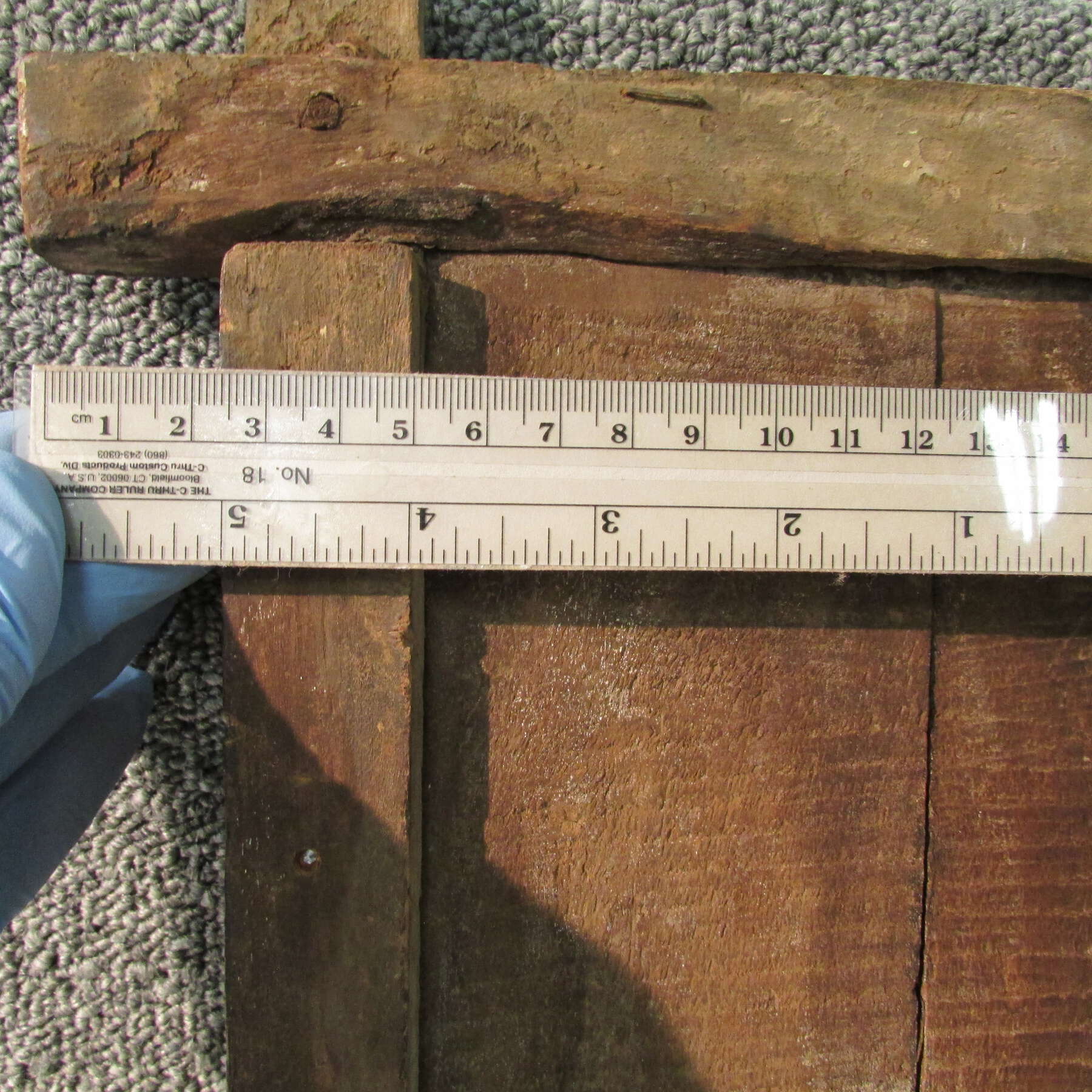 Figure 9.iv
Although great attention was paid to hiding imperfections of the frame members, some tool marks, however, were left quite visible—such as the saw marks on the lower tenons and on the reverse of the individual panels. The lack of visible plane marks on the reverse attests to the loftier skill of the handsaw operator.45
Regarding joinery, the pegs located in the proper left corners of the frame are raised off the surface (fig. ix.5). The raised nature of these pegs suggests that either they may have functioned for display purposes, existence used to hang cordage, or they were intended to exist accessible and tapped out on occasion, thereby making the frame more easily removable. An alternative theory proposes a deliberate pick past the maker: because these raised pegs would have been an encumbrance or an inherent vulnerability prone to breakage, they might have been an intentional aesthetic choice on the part of the frame maker.46
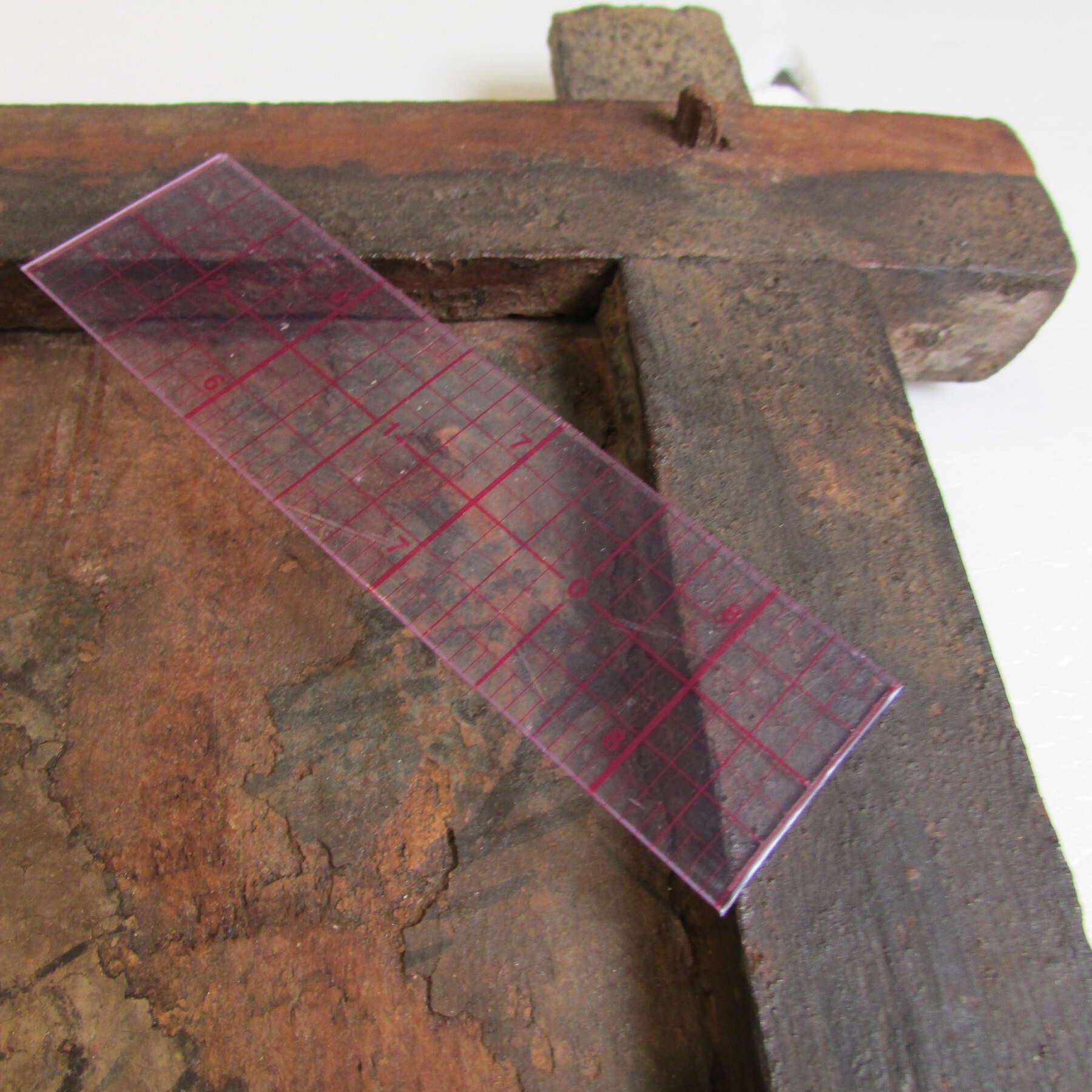 Figure 9.5
Curiously, in the proper upper right corner of the RISD frame, two pegs are next; the other corners possess only i. This second peg most likely served equally a signal of attachment to an auxiliary support (fig. 9.6). Another detail supporting this theory of attachment to an auxiliary support involves the two additional holes, located at the heart of both horizontal members, that also possess wooden pegs. These pegs differ from those located at the corners, every bit they are flush, every bit opposed to raised. The upper central peg is placed at the midpoint above the middle slat of the painting (fig. ix.7). In contrast, the lower central peg lies along a seam between ii of the painted slats. Therefore, the placement of these two central pegs does non appear to be related to stabilizing the painting itself; rather, these central pegs could have been used as a functional mechanism to attach the framed panel to an auxiliary surface.
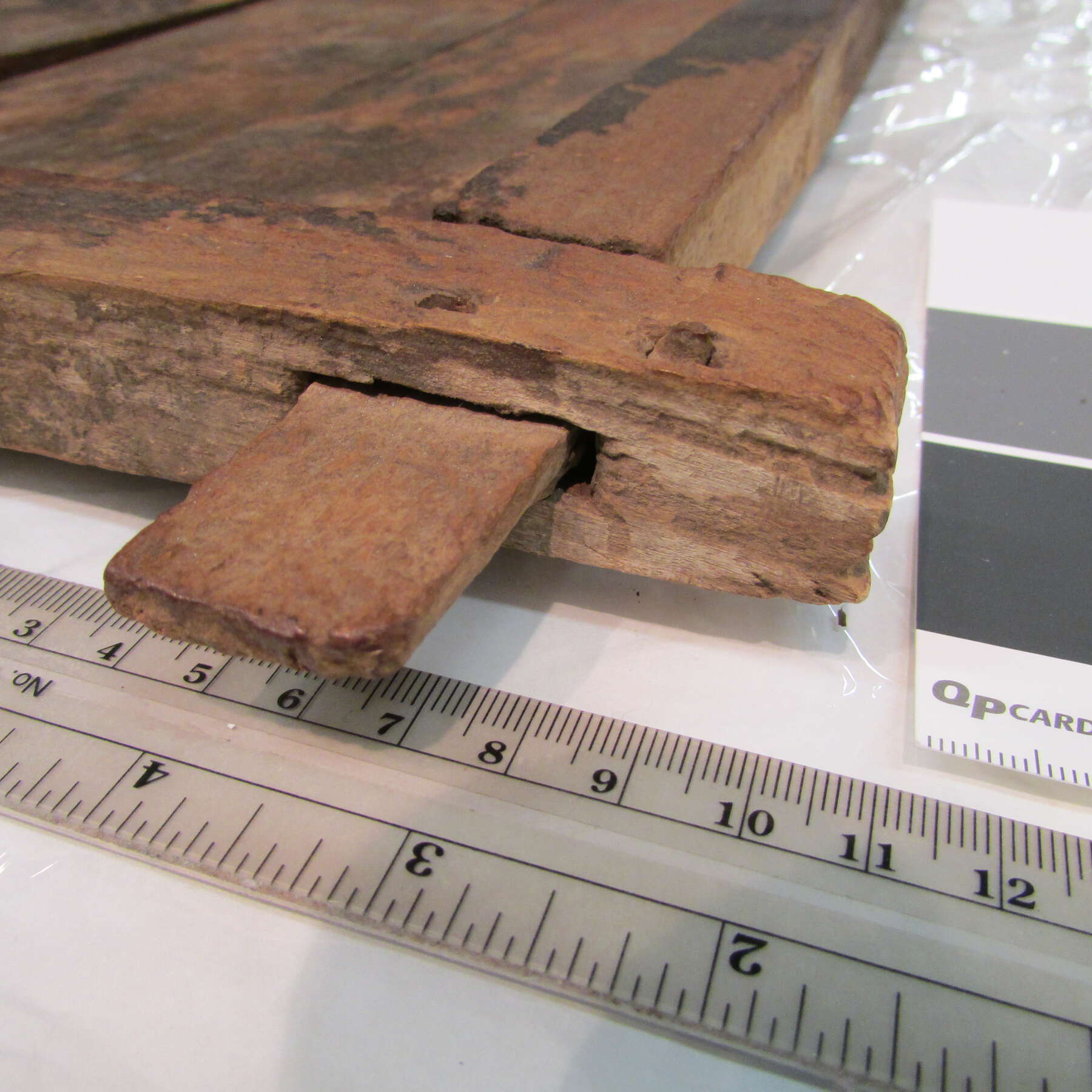 Effigy ix.half dozen
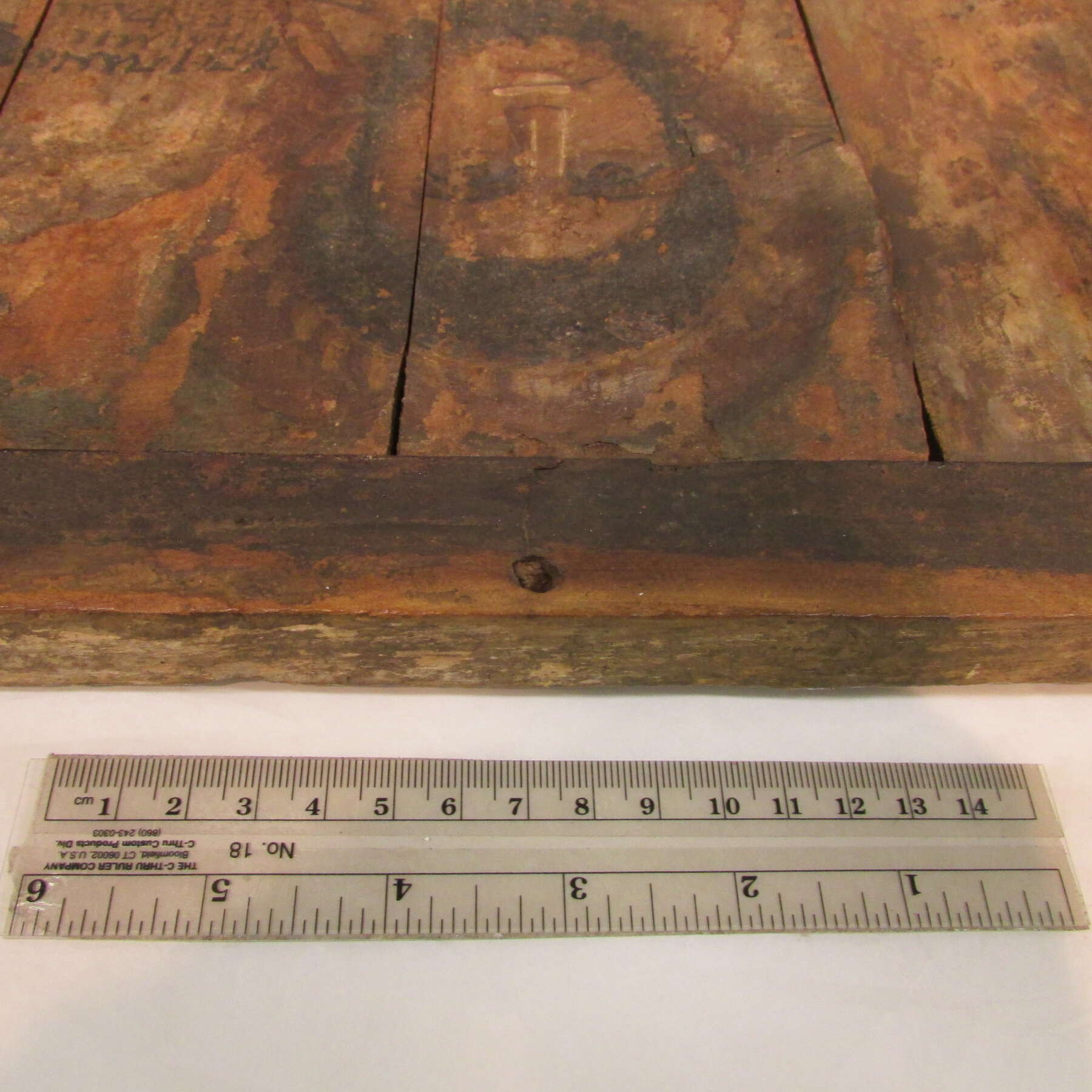 Effigy 9.vii
The painting was executed once the slats were inserted via tongue and groove into the frame, as dripped from the upper proper left-hand corner onto the inside of the adjacent frame member (see fig. ix.5), which suggests that the frame is original to the painting. This pigment has been analyzed as by and tin can exist seen clearly fluorescing on about the unabridged background of this prototype, except for the portion of the panel that is a modern replacement (fig. ix.viii). Paint besides extends up the interior surface of the frame members of the Brussels panel, but this does not appear to be the case with the framed portrait panel from the British Museum.
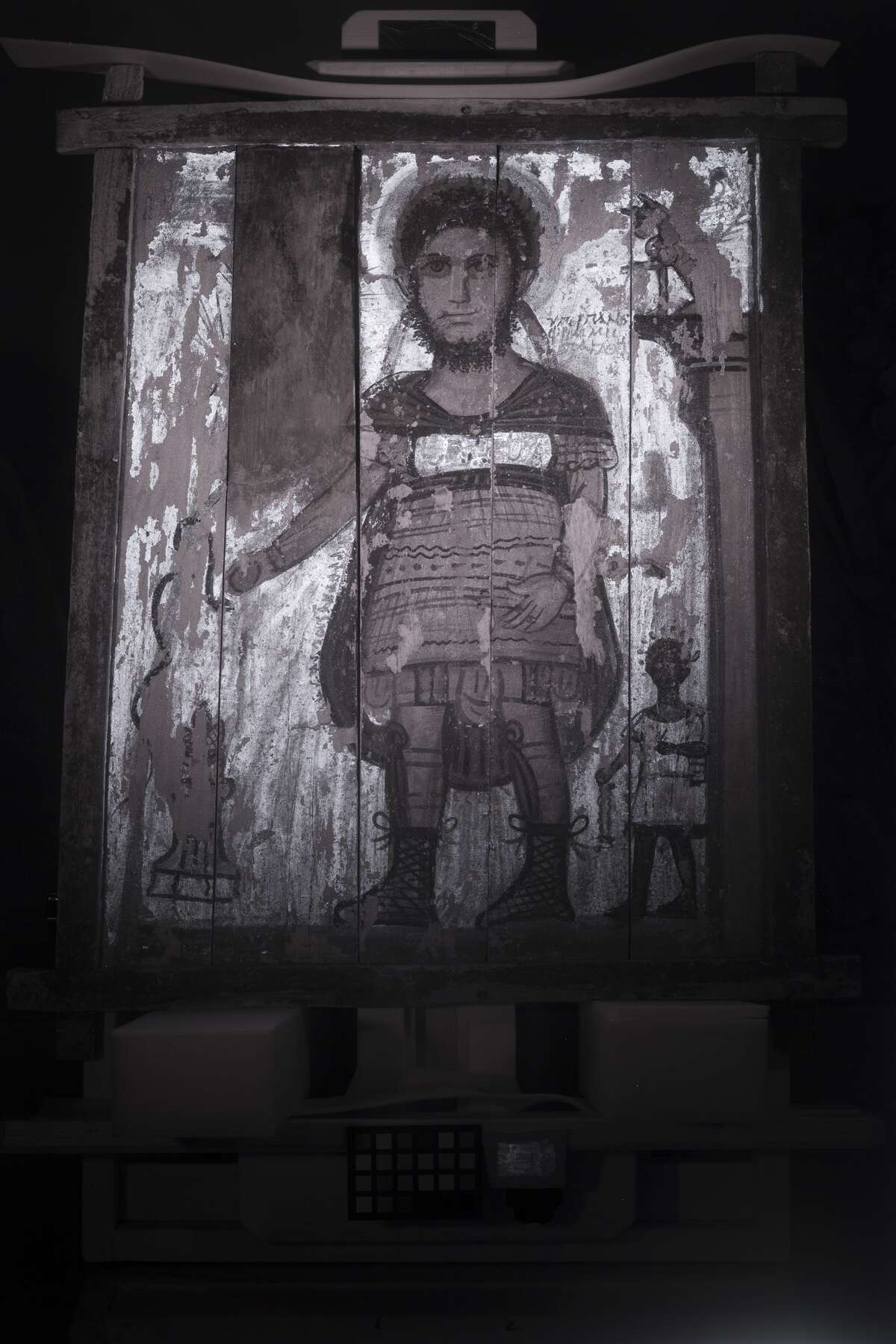 Figure 9.8
What is particularly interesting virtually the construction of the RISD panel, as compared with the other ii paintings, is that it is composed of five narrow slats of forest. This arrangement of multiple slats differs from the unmarried-panel structure of both the British Museum and the Brussels panels. The presence of a mitered wooden liner besides differentiates the British Museum panel painting (see fig. nine.3) from the other 2 examples.
The v slats on the RISD console are arranged in an irregular pattern of nonparallel boards with straight edges but not of equal widths; they are not actually rectangular. These irregularly shaped slats reflect the narrow sidr tree boughs, which would accept been in limited quantity and therefore a valuable article. The alternation of wide- and narrow-ended slats is indeed a audio thought from a woodworking perspective, equally the slats are more than dimensionally stable in this arrangement. Information technology is clear that all of the edges of the panels have been planed to exist direct and that they originally fit tightly with no perceptible gaps. The two slats on the viewer's right appear to be volume-matched, derived from the same tree bough. Based on the forest grain pattern, the center wooden slat might also originate from the same tree bender, admitting from a slightly unlike location (fig. nine.9).47 These individual slats besides contain many knots, ane of which appears to exist a bawl "inclusion," where bawl has grown into a knot and has left a smooth surface when viewed on the reverse.48
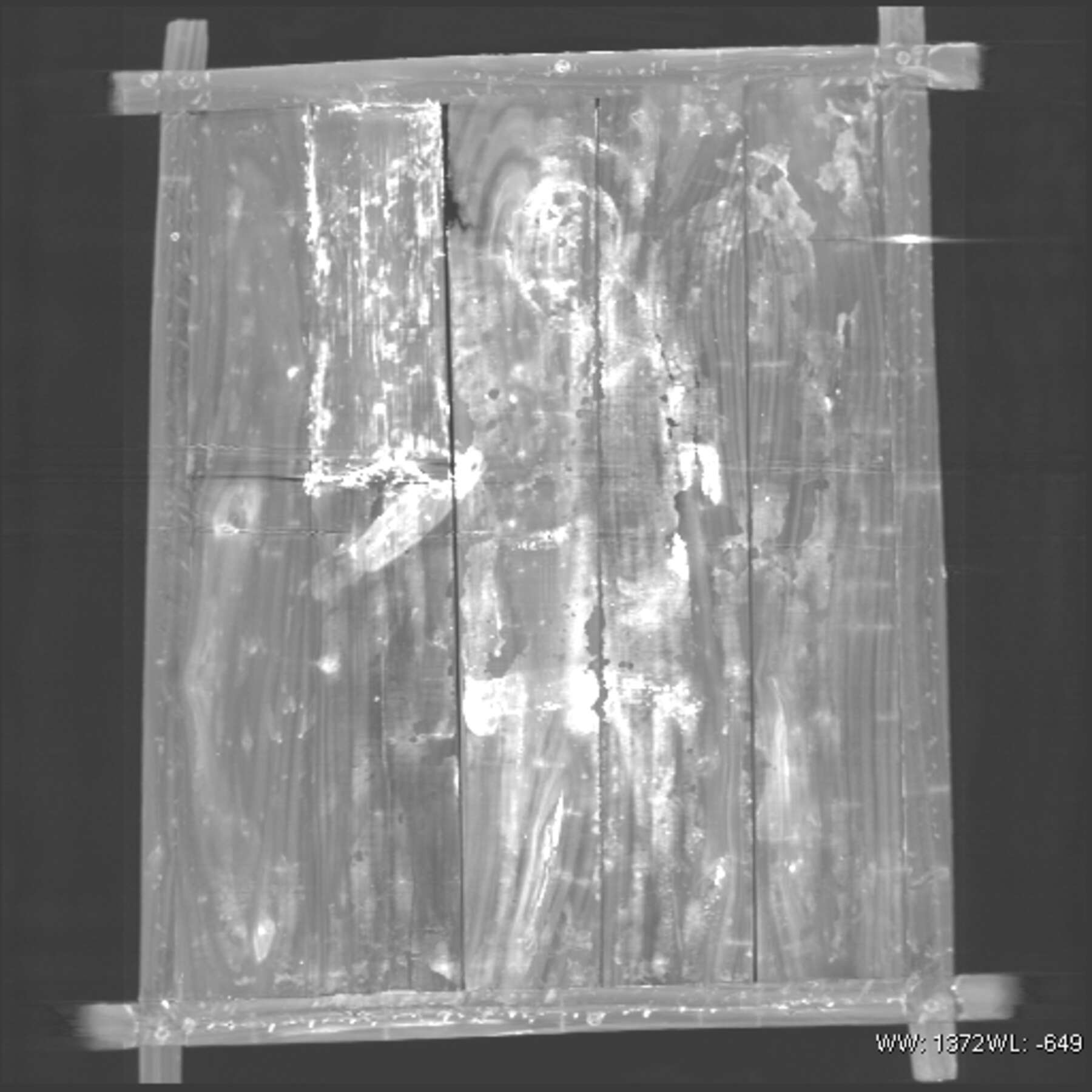 Figure 9.9
3-dimensional book rendering, undertaken at the Rhode Island Hospital, revealed an irregular void forth the interior perimeter of the frame (fig. 9.10). Material present in the void may have been an adhesive; however, it is non physically possible at this fourth dimension to obtain a sample from the interior groove.
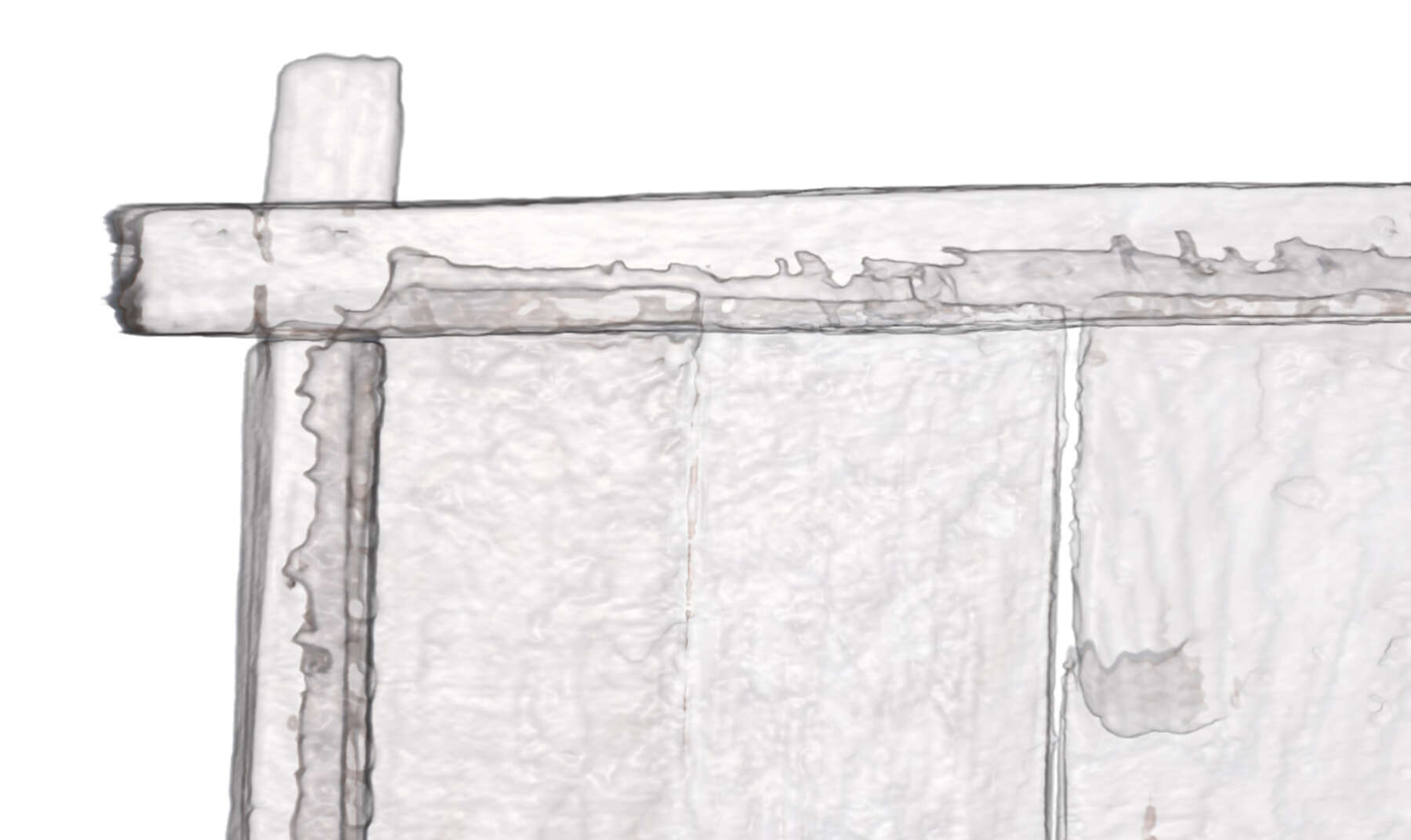 Figure nine.10
In addition to the Egyptian bluish pigment, other pigments were identified by ways of ii rounds of spectroscopy in 2016 and 2017 (fig. nine.11).49 The semiquantitative data are consistent with other analyses that we accept completed to date. The presence of calcium and sulfur in all samples is consistent with a binder or, alternatively, could point , ofttimes used as a substrate for . Silicon and aluminum were found in all samples, indicating the presence of a clay. Some interesting findings from the XRF data are the loftier levels of lead in the lips, indicating , potentially mixed with madder lake. Copper was found in several areas of the painting, including the gray background, the altar, the modest effigy's robe, Heron'southward breastplate, and fifty-fifty Heron's scarlet halo. Nosotros are confident virtually identifying the copper as consistent with the presence of Egyptian blue because these areas also fluoresce during VIL analysis.
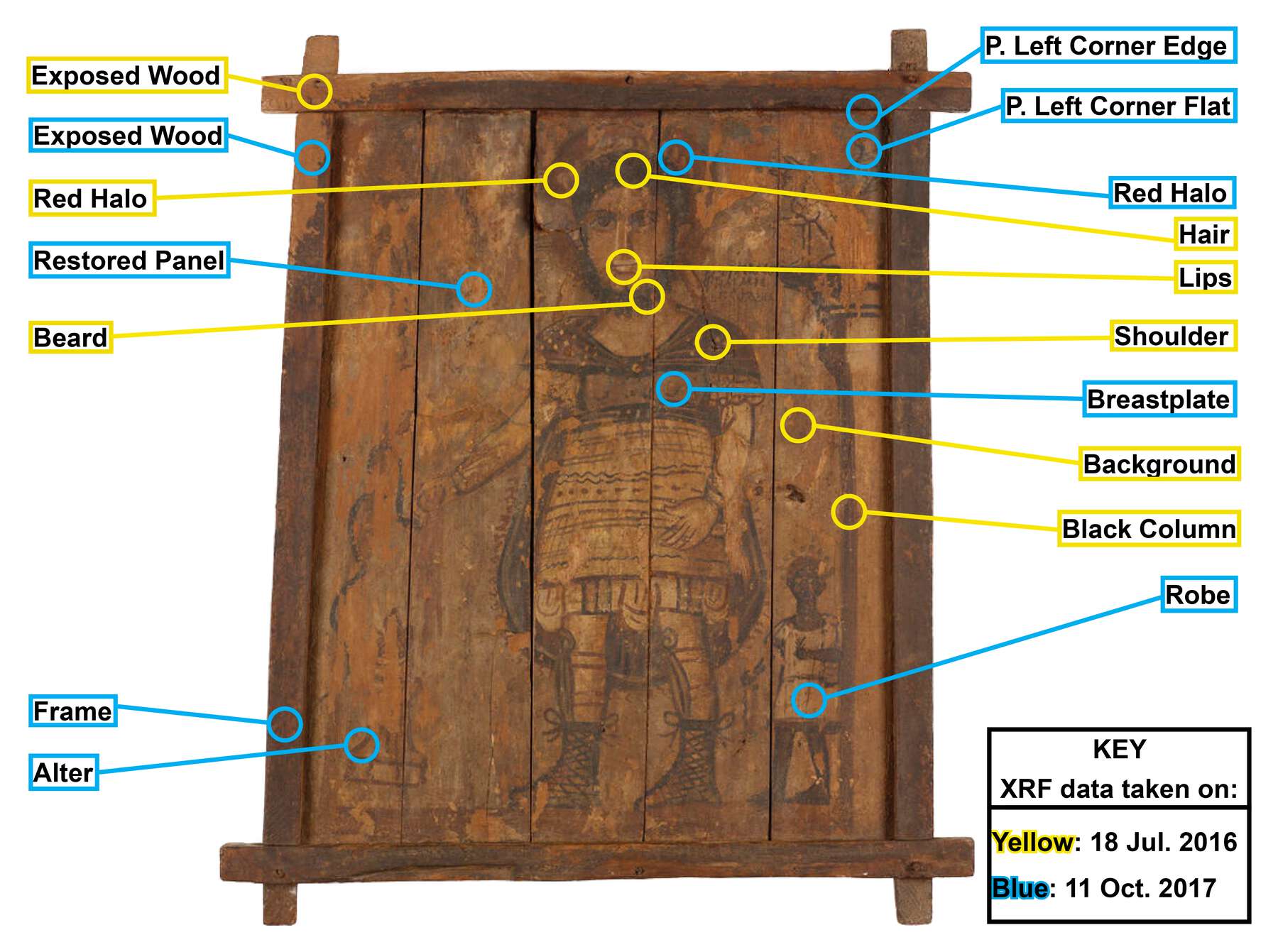 Figure ix.11
The label of the binding medium by means of infrared microspectroscopy was also conducted.fifty The paint sample taken from below the proper right foot produced spectra that indicate that one particle primarily contains gypsum and an oxalate. Another particle primarily contains a stearate compound. An additional organic fabric, such every bit an oil, may besides be present, just identification by was uncertain. Assay of a second sample indicates the presence of many inorganic compounds and a water-soluble binder with a reasonable resemblance to plant .
In that location are notable differences in the woods and the fashion of frame betwixt the RISD panel (see fig. 9.ii) and the pocket-size Portrait of a Adult female in the British Museum (see fig. 9.iii).51 While the RISD panel is composed of five slats of sidr forest, the British Museum panel is much smaller in scale and is composed of a unmarried piece of Ficus sycomorus, sycomore fig wood.52 The fact that the British Museum panel is a single plank speaks to the relatively larger size of sycomore fig wood, whereas the more than atomic scale of the sidr forest corresponds with the narrow slats of the RISD panel. The Brussels painting is besides equanimous of a unmarried panel, but the assay of its woods has not been undertaken.
Another deviation among these 3 panels is that the British Museum frame exhibits 2 parallel grooves, whereas the RISD and Brussels frames accept only one groove into which their painted panels have been inserted. The British Museum frame appears to have been cutting from prefabricated frame stock, as both grooves extend past the mortise and tenon (fig. 9.12).
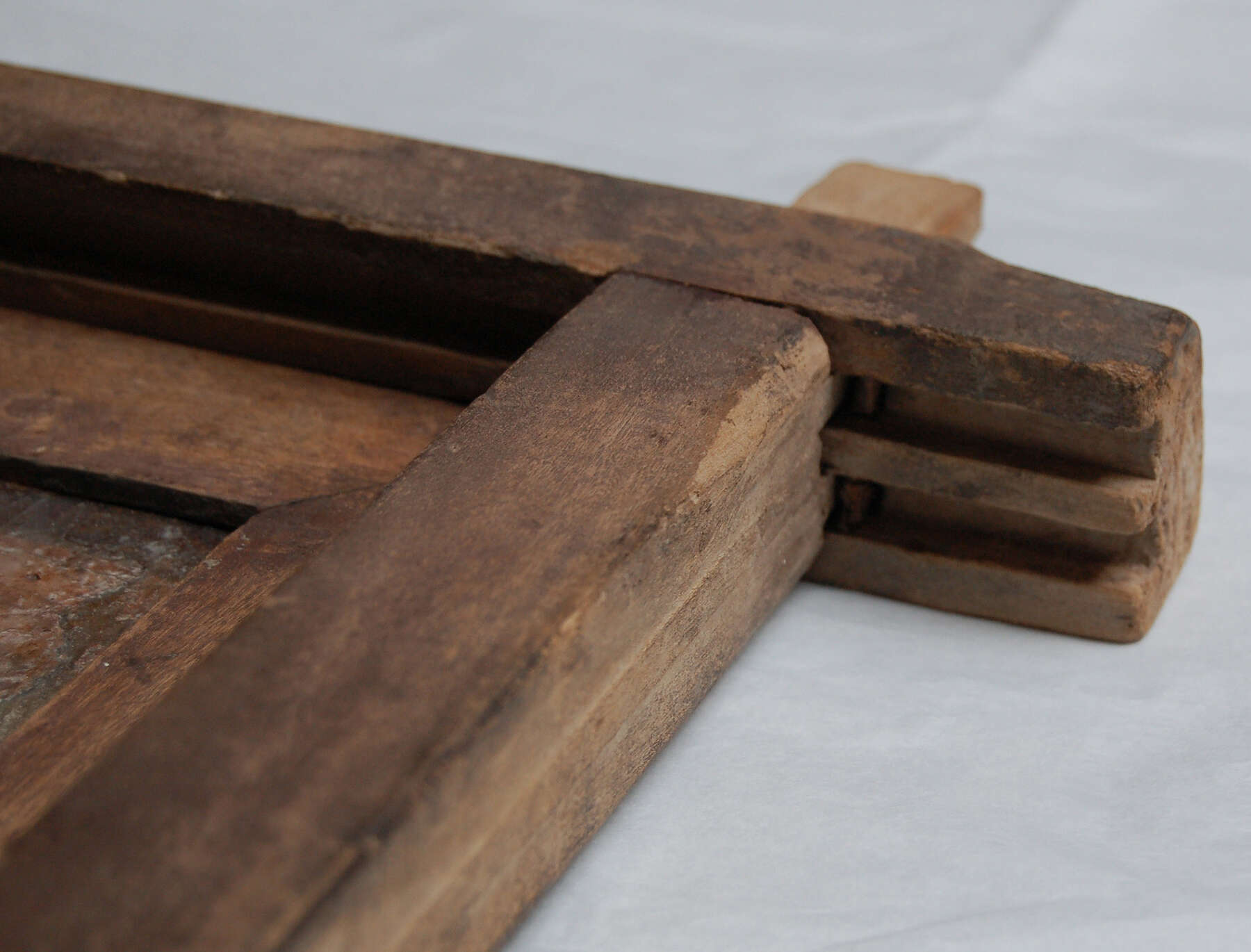 Figure 9.12
What would the office take been of the empty uppermost groove, measuring 0.7 centimeters in width, on the British Museum frame? If there were some sort of protective cover, such as a hinged wooden door panel on either side, the existing wooden liner could have served as a spacer to keep the protective doors from abrading the surface of the painting. Interestingly, a wooden hinge does survive from Saqqara in the drove of the Birmingham Museum and Art Gallery (fig. 9.13).53 Could a like swivel originally have served this purpose for the British Museum frame?
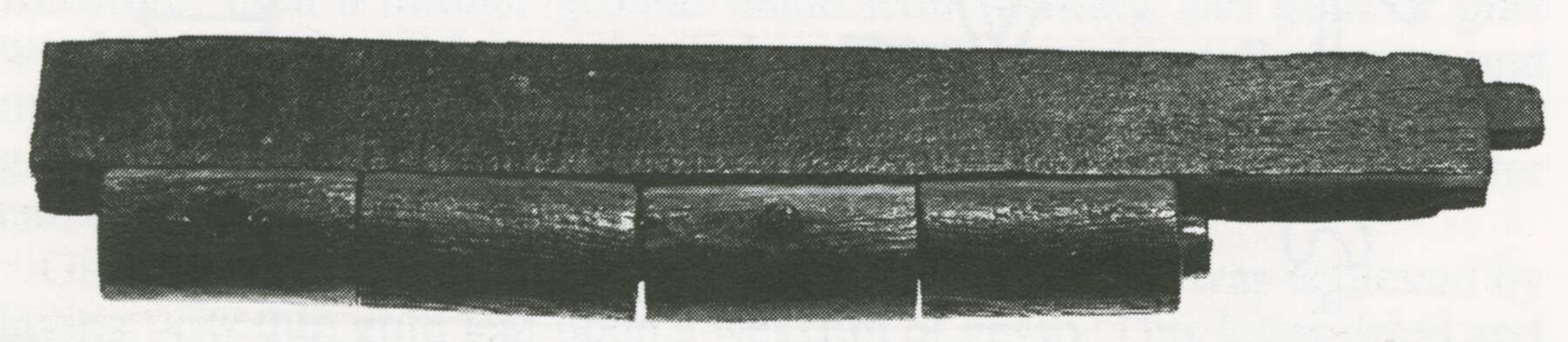 Figure nine.xiii
An boosted difference among the three panels is that the frames for the smaller, single-plank British Museum and Brussels panels do not possess the wooden pegs that are so prominent in the corners of the RISD frame; notwithstanding, the British Museum frame is the only example of the 3 that possesses the braided cordage with which to hang the framed panel. According to the Appear website, this cordage has been identified every bit palm (fig. 9.14).54 Visual inspection reveals that the cordage has been repaired in the modern era with Japanese newspaper.
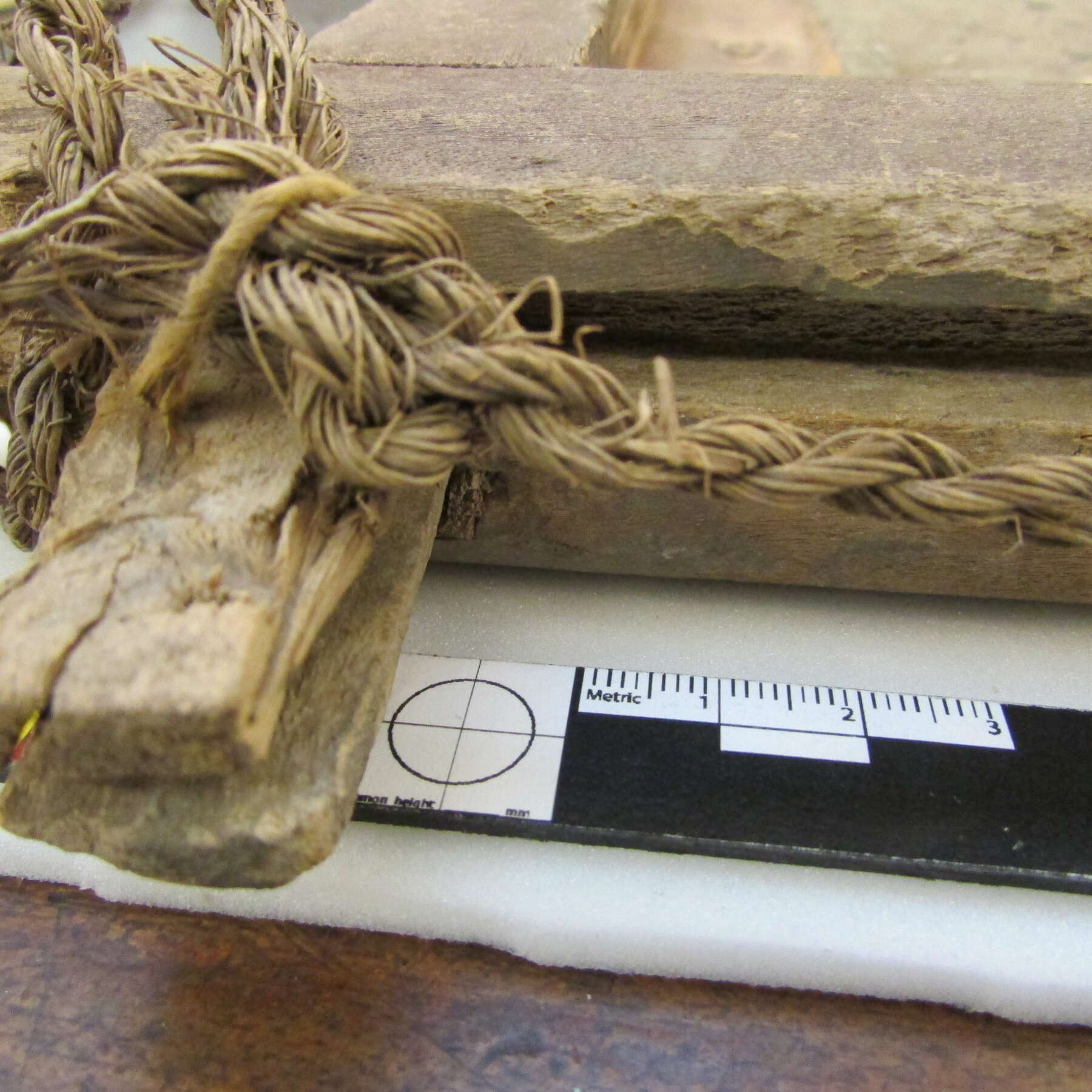 Figure 9.14
Unfortunately, the painted surface of the British Museum panel itself does non survive in good status. Its surface appears to have a alkane series consolidant, possibly present from the time of excavation.55 In contrast, the painted surface on the Brussels console is in very good status. Its surface possesses a matte and lean paint layer similar to that on the RISD panel.
As a midsize establishment with a collection of one hundred thousand objects, the RISD Museum was able to contribute to and do good from this international exploration in a valuable, symbiotic way. The APPEAR projection has immune us to dig deeper inside our own drove and explore others located beyond the globe. Closer to home, it has helped united states create new connections and strengthen collaborations with the geologists at Brown University as well as image specialists at Rhode Island Hospital, both of which are only footsteps abroad from our institution. In summer 2017, an undergraduate conservation intern funded by the Andrew Due west. Mellon Foundation created a digital reconstruction of the RISD panel as her concluding project (fig. 9.15). On behalf of the RISD Museum, we are very grateful to the Department of Antiquities at the Getty Villa for the opportunity to participate in this unique and educational projection.
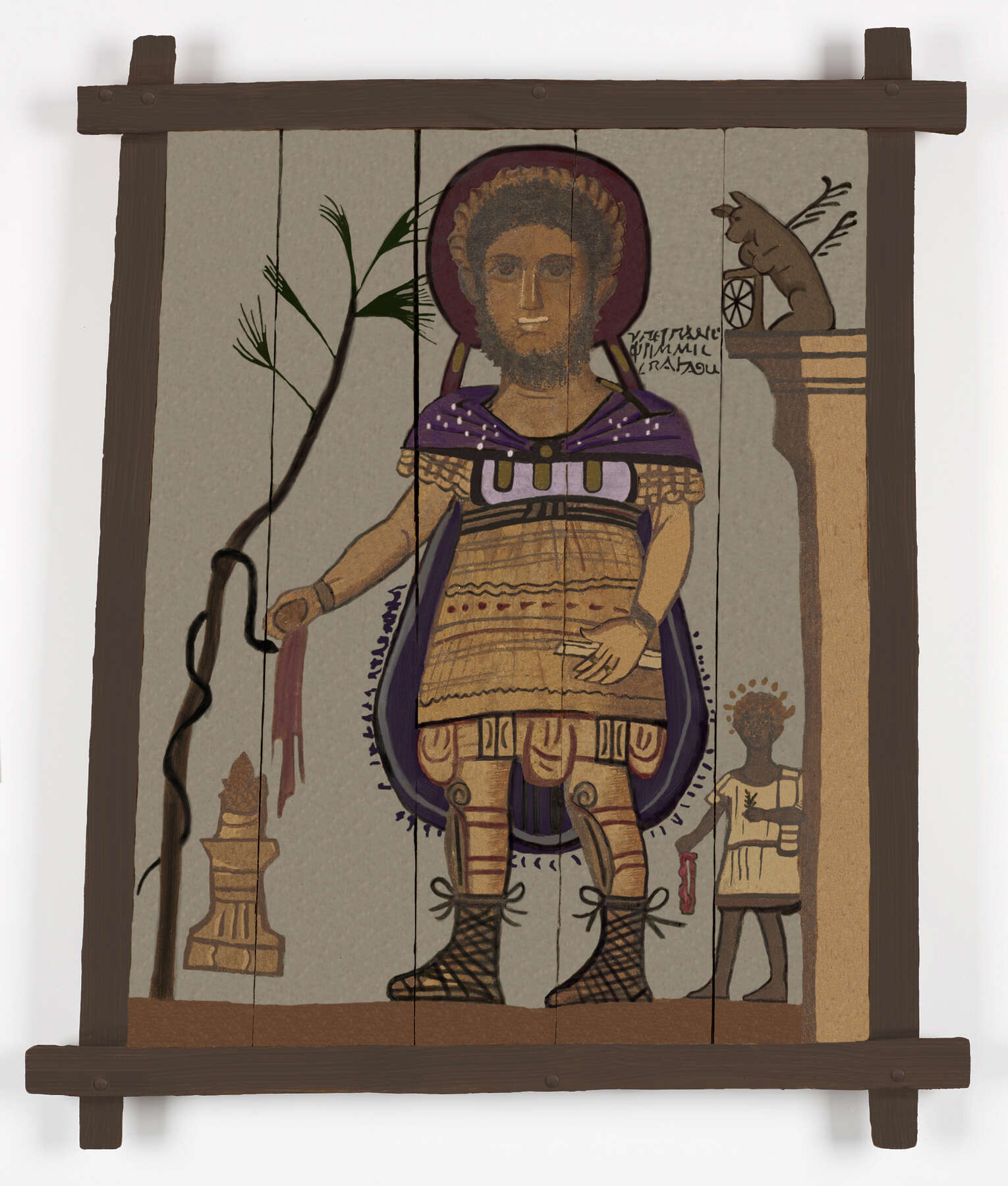 Figure ix.xv
Notes
© 2020 Georgina Eastward. Borromeo, Ingrid A. Neuman, Catherine Cooper, Scott Collins, David Murray, and Derek Merck. Originally published in Mummy Portraits of Roman Egypt: Emerging Inquiry from the Appear Projection © 2020 J. Paul Getty Trust, www.getty.edu/publications/mummyportraits (licensed under CC BY iv.0).
Source: https://www.getty.edu/publications/mummyportraits/part-one/9/
0 Response to "70 X 35 Hinged Four Panel Wall Art of Herons"
Post a Comment